PVL: Parameter Value Language
|
|
PVL: Parameter Value Language
|
An Aggregate implements a Parameter that is a list of Parameters. More...
#include <Parameter.hh>
Classes | |
| class | Depth_Iterator |
| A Depth_Iterator is a bidirectional iterator over an Aggregate's Parameter list and, depth-first, over the Parameter list of each Aggregate encountered. More... | |
Public Types | |
| enum | { CASE_INSENSITIVE, CASE_SENSITIVE } |
| Flags for find case sensitivity argument. More... | |
| typedef Parameter_List::const_iterator | const_iterator |
| Identify the iterator for compilers that need help. | |
| typedef Depth_Iterator | depth_iterator |
| A specialized iterator that descends into Aggregates in the Parameter list. | |
| typedef Parameter_List::iterator | iterator |
| Identify the iterator for compilers that need help. | |
| typedef Vectal< Parameter > | Parameter_List |
| Aggregate as a Vectal (vector) of Parameters. | |
Public Member Functions | |
| Aggregate & | add (const Parameter ¶meter) |
| Adds a clone of the Parameter to the end of the Aggregate's Parameter list. | |
| Aggregate & | add (Parameter *parameter) |
| Adds the Parameter to the end of the Aggregate's Parameter list. | |
| Aggregate (const Aggregate &aggregate) | |
| Copy constructor. | |
| Aggregate (Parser &parser, const std::string name="") | |
| Constructs an Aggregate using a Parser to provide its contents. | |
| Aggregate (const std::string name="", const idaeim::PVL::Parameter::Type type_code=Default_Subtype) | |
| Constructs an empty Aggregate. | |
| Aggregate (const Parameter ¶meter) | |
| Copy constructor from a Parameter. | |
| Depth_Iterator | begin_depth () |
| Gets a Depth_Iterator positioned at the beginning of this Aggregate. | |
| Aggregate * | clone () const |
| Clones the Aggregate by making a copy of itself. | |
| int | compare (const Parameter ¶meter) const |
| Compares this Aggregate with another Parameter. | |
| Aggregate & | copy_in (const Aggregate &aggregate) |
| Copies the Parameter list in an Aggregate into this Aggregate's list. | |
| Depth_Iterator | end_depth () |
| Gets a Depth_Iterator positioned at the end of this Aggregate. | |
| void | entering (Parameter *parameter) |
| Sets the parent of a Parameter to this Aggregate. | |
| Parameter * | find (const std::string &pathname, bool case_sensitive=false, int skip=0, idaeim::PVL::Parameter::Type type=(Type)(ASSIGNMENT|AGGREGATE)) const |
| Find a named Parameter. | |
| bool | is (const Type type) const |
| Test if the Parameter is of some Type. | |
| bool | is_Aggregate () const |
| Test if this is an Aggregate. | |
| bool | is_Group () const |
| Test if this is a Group Aggregate. | |
| bool | is_Object () const |
| Test if this is a Group Aggregate. | |
| Aggregate & | move_in (Aggregate &aggregate) |
| Moves the Parameter list in an Aggregate into this Aggregate's list. | |
| Aggregate & | operator= (const Parameter ¶meter) |
| Assigns a Parameter to this Aggregate. | |
| Aggregate & | operator= (const Aggregate ¶meter) |
| Assigns an Aggregate to this Aggregate. | |
| Aggregate & | operator= (const Assignment ¶meter) |
| Assigns an Assignment to this Aggregate. | |
| Aggregate & | operator= (const Value &value) |
| An Aggregate doesn't have a Value, so this always throws an Invalid_Argument exception. | |
| const Parameter & | operator[] (unsigned int index) const |
| Gets the Parameter at an index of the Aggregate list. | |
| Parameter & | operator[] (unsigned int index) |
| Gets the Parameter at an index of the Aggregate list. | |
| void | read (std::istream &in=std::cin) |
| Reads an input stream parsed as PVL syntax into this Aggregate. | |
| void | read (Parser &parser) |
| Parameters read by a Parser are added to this Aggregate. | |
| Parameter * | remove (size_type index) |
| Removes a Parameter at an element index of the Aggregate's Parameter list. | |
| Parameter * | remove (Parameter *parameter) |
| Removes a Parameter from the Aggregate's Parameter list. | |
| Parameter * | remove (iterator position) |
| Removes a Parameter at an iterator position from the Aggregate's Parameter list. | |
| Parameter * | remove_depth (Parameter *parameter) |
| Removes a Parameter from the Aggregate's Parameter list or any of its sub-lists. | |
| void | removing (Parameter *parameter) |
| Resets the parent of a Parameter to NULL. | |
| size_type | total_size () |
| Counts the number of Parameters in the Aggregate's Parameter list and, recursively, the number of Parameters in the Parameter list of each Aggregate in the list. | |
| Aggregate & | type (const int type) |
| Sets the Type specification. | |
| Type | type () const |
| Gets the Type specification. | |
| std::string | type_name () const |
| Gets the name for this Aggregate's Type specification. | |
| Value & | value () const |
| An Aggregate doesn't have a Value, so this always throws an Invalid_Argument exception. | |
| ~Aggregate () | |
| Destroys an Aggregate by clearing the Parameter list. | |
Static Public Member Functions | |
| static Type | default_type () |
| Gets the default Type specification to be used when constructing a new Aggregate without a Type specified. | |
| static Type | default_type (const int type) |
| Sets the default Type specification to be used when constructing a new Aggregate without a Type specified. | |
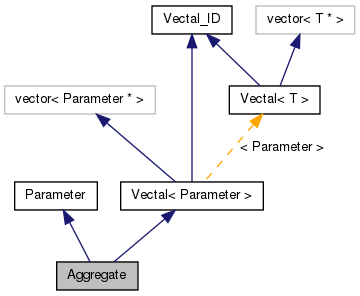
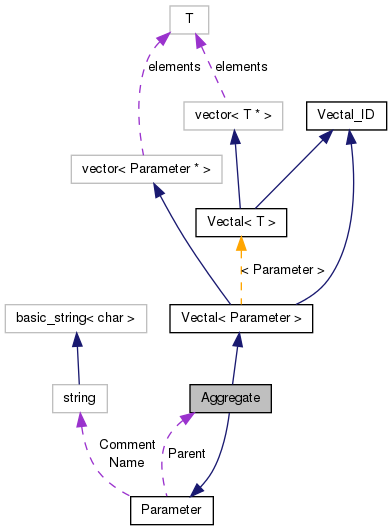
An Aggregate implements a Parameter that is a list of Parameters.
An Aggregate provides for the hierarchical structuring of Parameters.
The list is provided by subclassing a Vectal of Parameters. A Vectal is a vector of virtual objects that are stored as pointers but for which reference semantics are offered in the access interface. However, the normal value functionality is also provided by copying (actually cloning) objects into the list and deleting them on removal. An Aggregate ensures that, normally, whenever a Parameter is entered into its list the parent of the Parameter is set to the Aggregate. Thus the hierarchical relationships are automatically maintained. Provision is also made for pulling a Parameter from an Aggregate's list without deleting it, but also automatically resetting its parent to NULL to correctly reflect that it is no longer a member of the Aggregate hierarchy.
In addition to the normal vector interators for traversing an Aggregate's Parameter list, specialized Depth_Iterators are provided that descend into Aggregates encountered in a Parameter list. They continue iterating the parent list where they left off after completing the interation of a child Aggregate. They also remember the root Aggregate where they started, which is where they will end. These iterators are bidirectional with some random access capabilities.
| typedef Vectal<Parameter> Parameter_List |
| typedef Parameter_List::iterator iterator |
Identify the iterator for compilers that need help.
Reimplemented from Vectal< Parameter >.
Identify the iterator for compilers that need help.
Reimplemented from Vectal< Parameter >.
| typedef Depth_Iterator depth_iterator |
A specialized iterator that descends into Aggregates in the Parameter list.
| anonymous enum |
| Aggregate | ( | const std::string | name = "", |
| const idaeim::PVL::Parameter::Type | type_code = Default_Subtype |
||
| ) | [explicit] |
Constructs an Aggregate using a Parser to provide its contents.
This is the same as constructing an empty Aggregate and then using the Parser::add_parameters(Aggregate&) method on it. Note that the Parameters obtained from the Parser are all added as elements of the new Aggregate. Thus even if the Parser only finds one Parameter - e.g. from a string defining a single Group - the result will be an Aggregate containing a single Parameter element.
Note: If the new Aggregate is given the name Parser::CONTAINER_NAME then when the Aggregate is written to an ostream, only the content Parameters will be written.
| ~Aggregate | ( | ) |
| Aggregate* clone | ( | ) | const [inline, virtual] |
Clones the Aggregate by making a copy of itself.
Implements Parameter.
References Parameter::Aggregate.
| bool is_Aggregate | ( | ) | const [inline, virtual] |
| bool is_Group | ( | ) | const [inline, virtual] |
Test if this is a Group Aggregate.
Reimplemented from Parameter.
References Parameter::GROUP.
| bool is_Object | ( | ) | const [inline, virtual] |
Test if this is a Group Aggregate.
Reimplemented from Parameter.
References Parameter::OBJECT.
| bool is | ( | const Type | type | ) | const [inline, virtual] |
Test if the Parameter is of some Type.
The test is the logical AND of the Parameter Subtype and the specified Type value. Thus, conceptually, the test is if the Parameter is any one of a possible combination of Types. For example, parameter.is (GROUP| OBJECT) will be true for any AGGREGATE parameter, which could just as easily be tested by parameter.is (AGGREGATE); and parameter.is (ASSIGNMENT | AGGREGATE) can be expected to always be true.
| type | The Type specification code against which to test the Parameter. |
Implements Parameter.
References Parameter::type().
| Type type | ( | ) | const [inline, virtual] |
Gets the Type specification.
Implements Parameter.
| Aggregate& type | ( | const int | type | ) | [virtual] |
Sets the Type specification.
| type | The Type specification for the Aggregate. |
| Invalid_Argument | If the type value is not GROUP or OBJECT. |
Implements Parameter.
| std::string type_name | ( | ) | const [inline, virtual] |
Gets the name for this Aggregate's Type specification.
Implements Parameter.
References Parameter::type_name().
| static Type default_type | ( | ) | [inline, static] |
Gets the default Type specification to be used when constructing a new Aggregate without a Type specified.
| static Type default_type | ( | const int | type | ) | [static] |
Sets the default Type specification to be used when constructing a new Aggregate without a Type specified.
| Invalid_Argument | If the type value is not GROUP or OBJECT. |
| Value& value | ( | ) | const [virtual] |
An Aggregate doesn't have a Value, so this always throws an Invalid_Argument exception.
| Invalid_Argument | always. |
Implements Parameter.
| Parameter& operator[] | ( | unsigned int | index | ) | [inline, virtual] |
| const Parameter& operator[] | ( | unsigned int | index | ) | const [inline, virtual] |
Assigns a Parameter to this Aggregate.
If the Parameter is an Aggregate its name, comment and Type specification are copied, but not its parent. The Parameter list from the other Aggregate is replicated (cloned) and replaces the current list. The replacement is overlap safe: an Aggregate from within this Aggregate can be assigned. The current Parameter list is set aside but not deleted until the list replacement has completed.
If the Parameter is an Assignment its clone is appended to the Parameter list.
Nothing is done when assigning a Parameter to itself.
| parameter | The Parameter to be assigned. |
Implements Parameter.
Assigns an Aggregate to this Aggregate.
| parameter | The Aggregate to be assigned. |
References Parameter::operator=().
| Aggregate& operator= | ( | const Assignment & | parameter | ) | [inline] |
Assigns an Assignment to this Aggregate.
| parameter | The Assignment to be assigned. |
References Parameter::operator=().
An Aggregate doesn't have a Value, so this always throws an Invalid_Argument exception.
| Invalid_Argument | always. |
Implements Parameter.
| int compare | ( | const Parameter & | parameter | ) | const [virtual] |
Compares this Aggregate with another Parameter.
A Parameter compared with itself is, of course, identical.
The Parameter names are compared and, if they are different, the result of this comparison is returned.
When the Parameter names are the same, an Aggregate is greater than an Assignment.
When comparing Aggregates with the same name, the greater is the one with the larger Parameter list (not including the size of Parameter lists in any Aggregates in the list). When the size of both lists is the same, then each Parameter in the list is compared in the order they occur in the list and the result of the first non-equal comparison is returned; thus for the best results sort both Aggregates first.
| parameter | The Parameter to compare against. |
Implements Parameter.
| Parameter* find | ( | const std::string & | pathname, |
| bool | case_sensitive = false, |
||
| int | skip = 0, |
||
| idaeim::PVL::Parameter::Type | type = (Type)(ASSIGNMENT|AGGREGATE) |
||
| ) | const |
Find a named Parameter.
The Parameter to be found may be specified by a simple name, a relative pathname or an absolute pathname. A simple name is the name of a Parameter itself. A relative pathname is a simple name preceeded by the pathname of an Aggregate Parameter that must contain the Parameter with the simple name. An absolute pathname is a pathname that begins with a pathname delimiter ('/'); i.e. it is a fully qualified pathname beginning at the root of the Aggregate hierarchy, compared to a relative pathname that may begin at any Aggregate in the hierarchy.
Since it is not necessary that the pathname to each Parameter be unique, the number of matching pathnames to skip before selecting a Parameter may need to be specified to get the desired Parameter. Also, a specific type of Parameter - an Aggregate of Parameters or an Assignment of Values - may be specified. When skipping parameters, only the specified type, if any, are counted.
| pathname | The pathname of the parameter to find. |
| case_sensitive | If true, the name search is case sensitive; case insensitive otherwise. |
| skip | The number of parameters that match the criteria to skip before selecting a matching parameter. A value less than or equal to zero selects the first match. |
| type | A Type code that specifies the type of Parameter that is to be selected. By default any Type (ASSIGNMENT or AGGREGATE) will be acceptable. |
| void read | ( | std::istream & | in = std::cin | ) | [virtual] |
| void read | ( | Parser & | parser | ) | [virtual] |
Parameters read by a Parser are added to this Aggregate.
All available Parameters are obtained from the Parser will be added to the end of this Aggregate's Parameter list. If the Parser produces an Aggregate then each Parameter in its list is moved into this Aggregate list if the list is currently empty; if the list is not empty the entire Aggregate that was obtained, not just its list of Parameters, is appended to the list. If the Parameter the Parser produces in not an Aggregate Parameter then it is appended to this Aggregate's list. If the Parser does not produce a Parameter, nothing is done.
| parser | The Parser from which to obtain Parameters. |
Implements Parameter.
Adds a clone of the Parameter to the end of the Aggregate's Parameter list.
| parameter | The Parameter to add. |
Adds the Parameter to the end of the Aggregate's Parameter list.
Note: The Parameter is not cloned; The Parameter pointer is placed directly in the Parameter list backing store. The parent of the Parameter is changed to this Aggregate.
| parameter | The Parameter to add. |
Moves the Parameter list in an Aggregate into this Aggregate's list.
Each Parameter in the source Aggregate Parameter list is moved to the end of this Aggregate's Parameter list. As a result the source Aggregate will be emptied.
| aggregate | The source Aggregate. |
Removes a Parameter at an iterator position from the Aggregate's Parameter list.
| position | A valid iterator for the Aggregate's Parameter list. |
Removes a Parameter at an element index of the Aggregate's Parameter list.
| index | An index of the Aggregate's Parameter list. |
| void entering | ( | Parameter * | parameter | ) |
Sets the parent of a Parameter to this Aggregate.
This method overrides the Vectal's method that is invoked whenever a Parameter is entered into the Parameter list. It is not intended for normal use since it affects the logical relationship of Parameters in an Aggregate hierarchy.
The uniquness of the Parameter in the path hierachy is ensured; loops are prevented.
| parameter | The Parameter whose parent is to be changed. |
| Invalid_Argument | If the parameter is in the Aggregate's path; i.e. the Parameter is already in the parent hierachy of the Aggregate, or is the Aggregate itself. |
| void removing | ( | Parameter * | parameter | ) |
Resets the parent of a Parameter to NULL.
This method overrides the Vectal's method that is invoked whenever a Parameter is removed from the Parameter list. It is not intended for normal use since it affects the logical relationship of Parameters in an Aggregate hierarchy.
| parameter | The Parameter whose parent is to be changed. |
| size_type total_size | ( | ) |
| Depth_Iterator begin_depth | ( | ) |
Gets a Depth_Iterator positioned at the beginning of this Aggregate.
| Depth_Iterator end_depth | ( | ) |
Gets a Depth_Iterator positioned at the end of this Aggregate.
 1.7.4
1.7.4